If you cook with gas, this applies to you
Local Law 157 added a third device to NYC’s detector requirements. Alongside the smoke alarms and carbon monoxide detectors you already know about, residences with gas service now need a natural gas alarm.
The reach here is what makes it different from most compliance rules. LL88 touches buildings over 25,000 square feet. LL97 touches large buildings. Local Law 157 touches anyone with a gas stove, a gas boiler, or a gas water heater — which is the large majority of homes in this city. And in our experience most of them still don’t have the device.
The quick test: if there is a blue flame anywhere in your home, you need a natural gas alarm. A carbon monoxide detector does not count — they detect different things.
A gas alarm is not a CO detector
This is the single most common misunderstanding we hear, and it matters, because the two devices protect against opposite failure modes.
Carbon monoxide is produced when fuel burns incompletely — a cracked heat exchanger, a blocked flue, a poorly ventilated appliance. It is odourless, and the danger is poisoning.
Natural gas is the fuel itself, unburned — a leaking connection, a valve left open, a failed fitting. Utilities add a sulphur odourant so leaks smell, but people sleep through it, lose the ability to smell it at sustained low concentrations, or simply are not home. The danger is explosion.
Different gas, different behaviour, different placement. Owning one has never satisfied the requirement for the other.
Where each device goes
NYC now expects three distinct devices in the right places. Roughly:
- Smoke alarms — inside or within 15 feet of every sleeping area, and on every level of the home.
- Carbon monoxide detectors — within 15 feet of sleeping areas, in any home with a fuel-burning appliance or an attached garage.
- Natural gas alarms — near gas appliances, positioned per the specific device’s listing.
That last one deserves emphasis: because natural gas is lighter than air and behaves differently from CO, mounting height and distance follow the manufacturer’s instructions for that model. Guessing is how a compliant-looking install fails inspection.
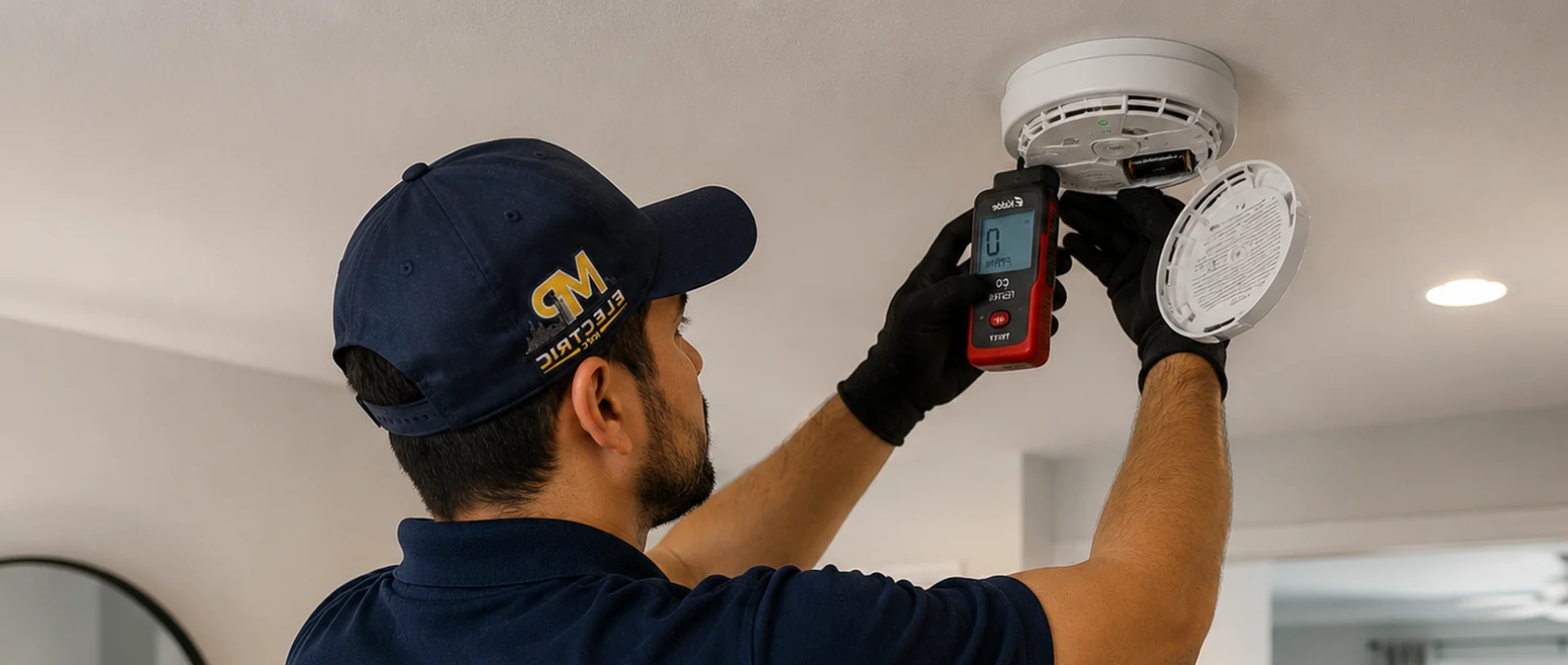
We map the required locations, install compliant smoke, CO and natural gas alarms, and hardwire or interconnect them where it makes sense. For landlords and managing agents we do whole-building sweeps with documentation.
Do you actually need an electrician?
Straight answer: not always, and we would rather tell you that than sell you something you do not need.
Plenty of natural gas alarms are plug-in or battery units. If you own your home, have a free receptacle near the appliance, and just need the device in place, you can handle that yourself.
Where we come in is when it is wiring work:
- Hardwired or interconnected systems — so every alarm in the home sounds together, which is the requirement in new construction and major renovations.
- Combination smoke/CO/gas devices tied into an existing hardwired loop.
- No receptacle where the device needs to go — a common problem near boilers and behind ranges.
- Multi-unit compliance sweeps — landlords and managing agents doing every unit at once, with documentation.
Most of our detector work is the last one. Owners rarely call about a single alarm; they call because they have twenty units and need it done properly and recorded.
Landlords and managing agents
If you own rental property, this sits in the same family as your existing smoke and CO obligations: provide and install compliant devices, notify tenants, replace on schedule, and keep records that prove it. The practical risk is not the device cost — it is a complaint or an inspection landing while units are non-compliant.
The efficient approach is a single sweep: every unit visited once, smoke and CO checked and replaced where expired, gas alarms added, hardwired units interconnected, and a unit-by-unit record produced at the end. That record is what protects you later.
What to do this week
Homeowners: walk your home. Gas appliance anywhere? Look for a gas alarm near it. If there is not one, that is your answer. While you are at it, check the date on your CO detector — they expire, and an expired unit is non-compliant even if it still chirps when tested.
Landlords and boards: find out how many of your units have gas alarms. If the answer is “I am not sure,” that is worth resolving before someone else asks the question.
Fair caveat: compliance details — the covered occupancies, the required device listing, and placement specifics — are set by DOB rule and can be updated. This article explains the requirement in general terms. For your specific building, confirm with NYC DOB, HPD, or your managing agent. It is guidance, not legal advice.
Frequently Asked Questions
If your home has gas service — a gas stove, boiler, or water heater — then yes, a natural gas alarm is required under Local Law 157. That describes the large majority of NYC residences, which is why so many homes are currently non-compliant without realising it.
No, and this is the most common mix-up. Carbon monoxide is a byproduct of incomplete combustion. A natural gas alarm detects unburned methane — a gas leak, before anything ignites. They detect different things and are placed differently. Having a CO detector does not satisfy LL157.
Near your gas appliances, positioned according to the manufacturer's listing for that specific device. Because natural gas is lighter than air it behaves differently from CO, so the device instructions govern the mounting height and distance. We map exact locations during the walkthrough.
Not always. Many gas alarms are plug-in or battery units a homeowner can place themselves. You need an electrician when you want hardwired or interconnected units, a combination smoke/CO/gas device tied into an existing hardwired system, or a receptacle added near a gas appliance where none exists.
Owners are responsible for providing and installing compliant devices, with obligations that parallel the existing smoke and CO rules — including tenant notice and replacement. For multi-unit buildings this is usually handled as a compliance sweep across all units at once, which is how we normally do it.
The requirement is ongoing, not a one-time date you missed. The fix is the same either way: install compliant devices in the right locations and keep records. For rental and multi-unit properties it is worth closing out before an inspection or a complaint puts it on the record.