// Licensed Electrician · Crown Heights · Brooklyn
Licensed Electrician
in Crown Heights
Crown Heights pairs grand pre-war apartment buildings with brownstone-lined side streets. Whether it's a multi-family building or a single-family rowhouse, the pre-war electrical challenges are our home territory.
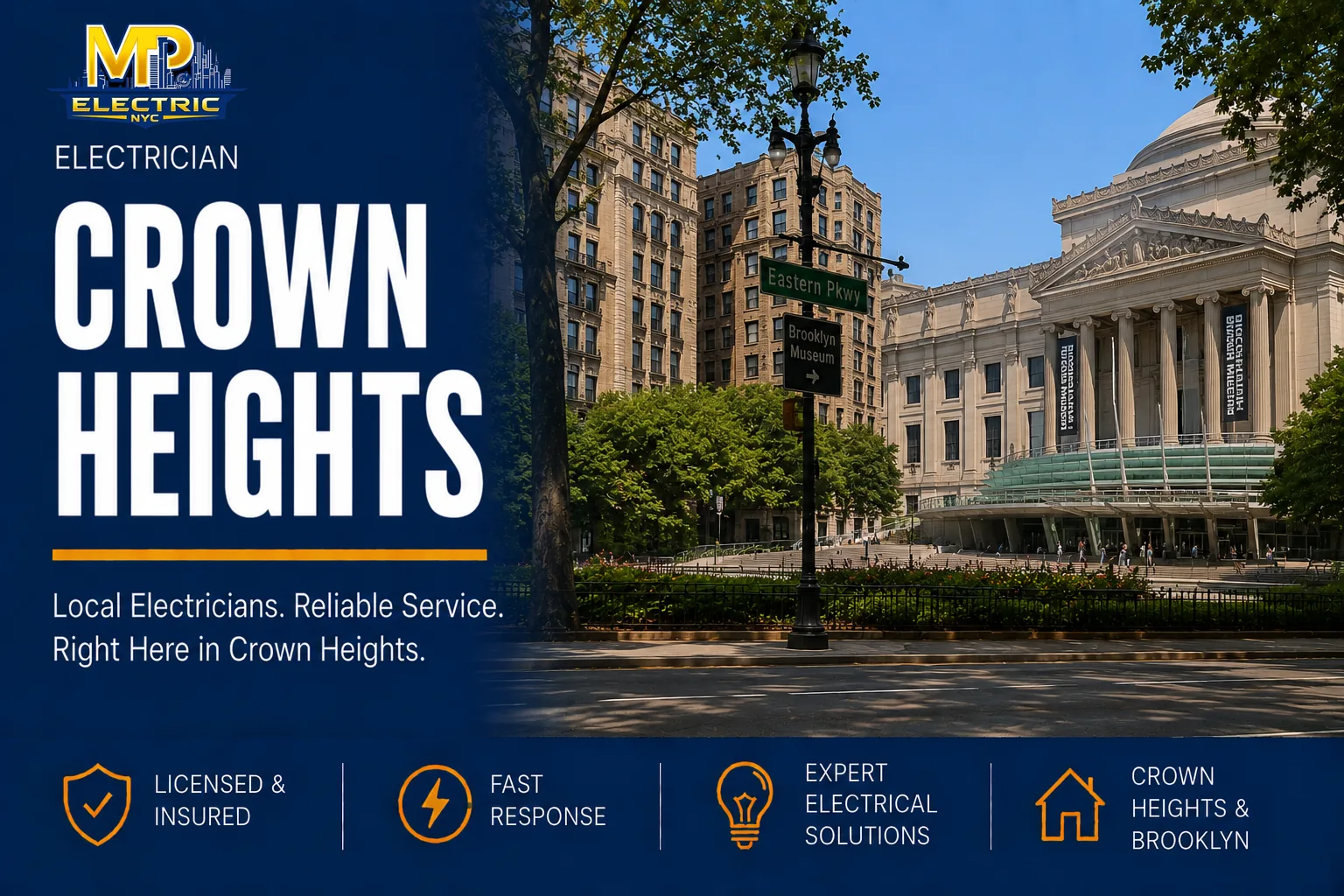
Crown Heights' building stock — and what it asks of an electrician
Crown Heights pairs grand limestone and brownstone rowhouses on the side streets with large pre-war apartment buildings and co-ops along Eastern Parkway and the avenues. The work splits between owner-occupied house upgrades and apartment-level circuit and panel work in the big buildings.
- Rowhouse modernization limestone and brownstone houses on knob-and-tube and old service — rewiring, panel upgrades, and brownstone work.
- Pre-war apartment-building electrical in-unit circuits, fuse-to-breaker conversions, and risers in the Eastern Parkway buildings — multi-family electrical.
- Two-family and owner-rental metering separate panels for owner and tenant units — multi-family metering.
- Renovation electrical dedicated circuits, lighting, and GFCI work on the steady stream of gut renovations.
Parts of Crown Heights fall inside historic districts — exterior-visible electrical is planned around LPC rules where they apply.
The physical building matters as much as its age. Crown Heights rowhouses tend to be deep — three or four stories over a garden level — with thick masonry party walls and original plaster-and-lath that make cable routing a craft rather than a quick pull; we plan runs to reach every floor without tearing up finished rooms. The grand pre-war apartment houses along Eastern Parkway concentrate load in shared risers and meter rooms, so capacity questions get answered at the building level before any single line is touched. Knowing which pattern you’re dealing with — and pricing the access, not just the device — is the difference between a clean quote and a mid-job surprise.
The electrical problems we see most in Crown Heights
Most Crown Heights electrical work traces back to the age and type of the building. On the landmarked side streets — the limestone and brownstone rowhouses of the Crown Heights North Historic District — we regularly find original knob-and-tube and early cloth-insulated wiring still in service behind plaster walls, alongside 60- to 100-amp services that were never meant to carry today’s air conditioning, induction ranges, and EV charging. The fix is usually a combination of rewiring and a service upgrade to 200 amps, run carefully so plaster and historic detail survive the process.
The mid-century apartment buildings and co-ops along Eastern Parkway and the avenues bring a different set: gang meter banks and house panels near capacity, fuse panels waiting to be converted to breakers, and — in some 1960s and ’70s buildings — aluminum branch wiring that needs proper remediation rather than a patch. Across both, we see the everyday hazards that come with older stock: ungrounded two-prong outlets, missing GFCI protection in kitchens and baths, AFCI requirements triggered by renovation, overloaded DIY circuits, and outdated Federal Pacific or Zinsco panels that insurers increasingly flag.
Toward the eastern end of the neighborhood, wood-frame and smaller multi-family houses add two- and three-family metering questions — separating loads cleanly, labeling correctly, and keeping each unit to code. Whatever the building, the goal is the same: a safe, documented, code-compliant system that a co-op board, an insurer, or a future buyer can trust.
Permits, Con Edison & the Crown Heights North Historic District
Nearly all of this is permitted work. As a master-licensed contractor we file the DOB electrical permit, carry the job through inspection, and secure sign-off — the paper trail your insurer, co-op board, or future buyer will ask for. Service upgrades are coordinated with Con Edison, whose lead times we build into the schedule so power comes back on plan, not by surprise.
Crown Heights also carries a landmark dimension. Much of the neighborhood’s historic core falls within the Crown Heights North Historic District, designated by the Landmarks Preservation Commission in phases beginning in 2007. Interior electrical work generally proceeds under a standard DOB permit, but anything visible from the street — a relocated meter, a new service entrance, exterior fixtures or conduit — can call for an LPC-appropriate approach. We plan those details up front so a service upgrade doesn’t stall on a landmark question. Pre-war owners can see the full framework in our pre-war modernization service and pre-war electrical guide.
We cover every part of Crown Heights — ZIP codes 11213, 11216, 11225, and 11238 — from Eastern Parkway and the Franklin Avenue corridor to Nostrand, Kingston, and Utica Avenues, and the blocks around Brower Park and the Brooklyn Children’s Museum. Wherever the 2, 3, 4, and 5 trains and the Franklin Avenue Shuttle reach, we’re a short dispatch away, with a few hours emergency response day or night.
What Crown Heights calls us for
The local greatest hits: rowhouse rewiring, panel and service upgrades, apartment-building and two-family metering, renovation lighting, and 24/7 emergency response.
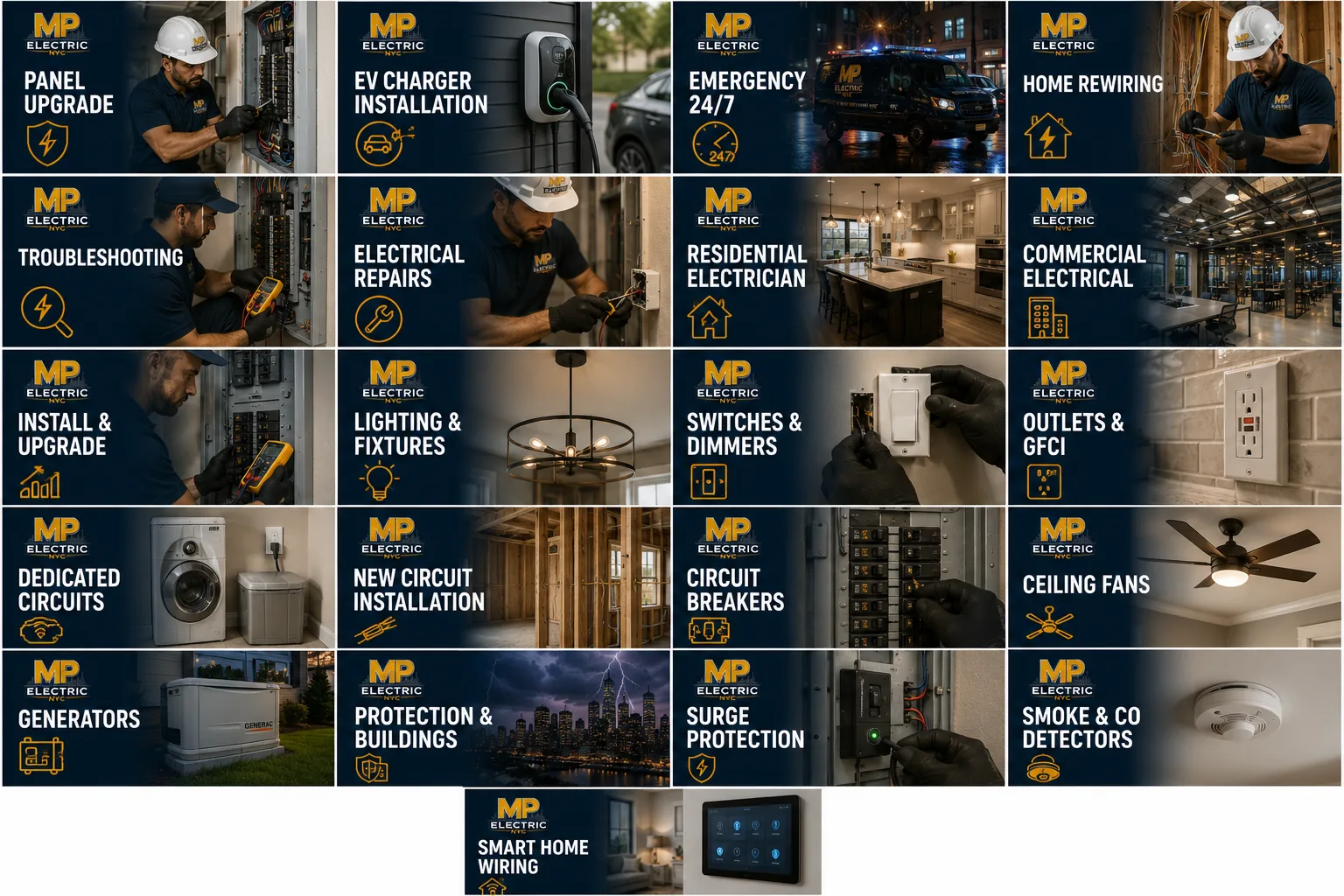
In practice, a handful of jobs come up again and again. Rowhouse rewiring and panel upgrades lead the list — owners modernizing a limestone or brownstone, often as part of a gut renovation or before a sale, replacing knob-and-tube and lifting service to 200 amps. Kitchen and bath renovations bring dedicated circuits, under-cabinet lighting, GFCI and AFCI protection, and the occasional 240-volt run for an induction range. Apartment and two-family metering work sorts out capacity and labeling in the bigger buildings, and recessed and renovation lighting turns dark pre-war rooms into bright, even spaces. When something fails — a dead line, a sparking outlet, a tripping main — our 24/7 emergency service covers Crown Heights with priority 24/7 dispatch. EV owners with driveways or a condo garage increasingly call for Level 2 charger installation, and landlords for violation cures and common-area work.
Crown Heights landmarks on our working map
Map & coverage
How we work in Crown Heights
Every Crown Heights job runs the same way, whether it’s a single outlet or a whole-house rewire: a clear written quote before we start, licensed permit filing where the work requires it, tidy execution that respects an occupied home or building, and dated documentation at the end. For owner-occupied brownstones that means photos and sign-off you can hand to an insurer or a buyer. For the co-ops and rental buildings along Eastern Parkway and the avenues, it means Certificates of Insurance on file, board and management coordination, and — for owners of several buildings — portfolio pricing and a single point of contact. The result is electrical you don’t have to think about twice.
Crown Heights FAQ
Yes — we cover all of Crown Heights and the surrounding Brooklyn neighborhoods, with 24/7 emergency response, typically within a few hours depending on availability and location, and standard scheduling within a few business days.
Standard appointments are typically scheduled within 2–5 business days, often same-week for smaller jobs. Emergencies get priority 24/7 dispatch, typically within a few hours depending on availability, throughout Crown Heights.
Yes — every job that requires a NYC DOB permit includes filing, inspection, and the Certificate of Electrical Inspection at sign-off. See our permits & inspections page for details.
Yes — unit turnovers, HPD violation cures, riser and service upgrades, and common-area lighting, with portfolio rates for owners of multiple buildings.
Yes. Interior electrical — rewiring, panel and service upgrades, new circuits — proceeds under a standard DOB permit. For anything visible from the street, like a relocated meter or new service entrance, we plan an LPC-appropriate approach up front so the job doesn’t stall, and historic plaster and detail are protected throughout.
Yes — it’s some of our most common work here. We rewire pre-war rowhouses room by room, fishing new cable through plaster walls with minimal disruption, and typically pair it with a 200-amp service upgrade so the home can carry modern loads. You get a code-compliant system and the documentation insurers require.
Yes. We provide the license and insurance certificates, alteration-agreement paperwork, and load documentation that Crown Heights co-op and condo boards require, and we coordinate with building management and supers for both common-area and in-unit work.
Most residential 150-to-200-amp service upgrades in the neighborhood run $4,000–$6,500 depending on service-entrance conditions, meter location, and any Con Edison work — quoted as a fixed price after a site visit. See our panel upgrade cost guide for the full breakdown.
Get a free quote anywhere in NYC
Tell us the neighborhood and the job — we'll confirm coverage and give you a written fixed price.