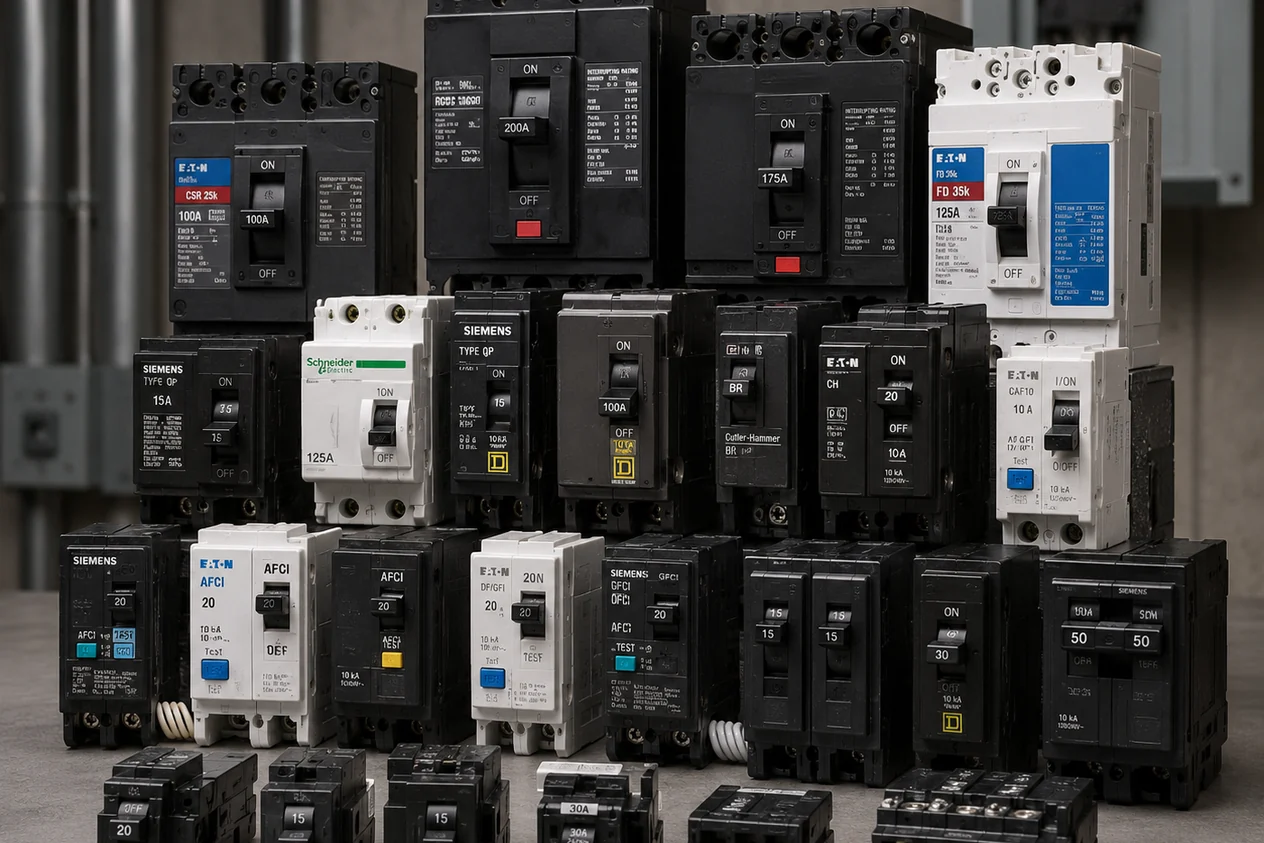
Diagnosis first — because the breaker is often the symptom, not the disease
Here's the order of operations that separates a correct repair from a parts-swap: a breaker that trips is usually protecting you from something else. Replacing it without finding out what is how the same problem comes back — or worse, hides until it causes a fire. See detailed 2026 cost ranges →
Before we replace any breaker, we determine which of four situations you're in:
- Overloaded circuit. The breaker is fine; the circuit carries more load than its rating. The fix is a dedicated circuit for the heavy appliance — not a bigger breaker.
- Short or ground fault. The breaker is fine; there's a wiring or appliance fault downstream. We locate and repair it.
- Failed breaker. Breakers wear out — internal mechanisms weaken after years of cycling, causing trips at well below rated current, failure to reset, humming, or heat. This is the replacement case.
- Failing panel. Multiple breakers misbehaving, a warm bus bar, or a recalled brand. Replacing breakers in a dying panel wastes money — see below.
The cardinal rule we will never break: a breaker is sized to protect the wire, not the appliance. Installing a larger breaker to stop nuisance trips lets the wiring carry more current than it's rated for. That's how electrical fires start, and any electrician who offers it should be shown the door.
Federal Pacific & Zinsco — when breaker replacement is the wrong answer
If your panel is a Federal Pacific Electric (FPE) Stab-Lok or Zinsco, we'll tell you before quoting a breaker swap — because putting new breakers into these panels is usually money wasted.
FPE Stab-Lok breakers have a documented history of failing to trip under fault conditions — the one job a breaker exists to do. Replacement Stab-Lok-compatible breakers from aftermarket makers inherit the same connection design. Zinsco breakers can overheat and fuse to the bus bar, leaving a circuit permanently energized through a fault.
Most NYC insurers now flag both brands, and many refuse coverage or require replacement at renewal. The honest math: a $250 breaker swap in an FPE panel buys you nothing your insurer will accept and nothing your family can rely on. A panel replacement ($1,200–$2,000 for same-amperage swap) is the fix that actually closes the risk.
Not sure what panel you have? Text us a photo of the open panel door — we'll identify it for free.
AFCI and GFCI breaker upgrades — protection your old panel never had
Modern code requires two protective breaker types that most NYC panels predate:
AFCI (Arc Fault Circuit Interrupter) breakers detect the electrical signature of arcing — frayed cords, loose connections, nails through cables — and trip before the arc ignites anything. Current NYC code requires them on bedroom and living-area circuits in renovations and panel replacements. In a pre-war building with aging wiring, AFCI breakers are arguably the single highest-value safety upgrade per dollar: $220–$450 per circuit, protecting against the leading cause of home electrical fires.
GFCI breakers protect an entire circuit against ground faults from the panel — an alternative to GFCI outlets that makes sense for circuits feeding multiple wet locations, exterior circuits, or finished walls where outlet swaps are disruptive. More on outlet-level protection at our outlets & GFCI service.
Both install in about an hour per circuit when your panel accepts modern breakers. We confirm compatibility before quoting — breaker brand and panel must match; mixing brands voids listings and fails inspection.
Circuit load calculator — do you need a bigger breaker or a dedicated circuit?
Add up what's running on one circuit (say, a kitchen counter with a microwave, toaster, and coffee maker) and this estimates the current draw. If you're pushing a standard 15A or 20A circuit past 80% of its rating, that's why your breaker keeps tripping — and a sign you may need a dedicated circuit or a panel upgrade. Enter wattages below:
Appliance load calculator
Service areas & related work
Circuit breaker replacement throughout Brooklyn, Queens, Manhattan, and the Bronx — usually same-day. In Brooklyn that spans Crown Heights, Bedford-Stuyvesant, Bushwick, Park Slope, Fort Greene, Prospect Heights, Cobble Hill, Carroll Gardens, Greenpoint, Williamsburg, and Flatbush — plus Boerum Hill, Clinton Hill, Ditmas Park, and Brooklyn Heights — and across Queens, including Howard Beach.
If breaker problems are part of a bigger pattern — multiple circuits acting up, a warm panel, a fuse box — start with our troubleshooting service or read when a panel upgrade is actually needed.
Frequently asked questions
Standard breaker replacement runs $150–$280 including diagnosis of why it failed. AFCI and GFCI breakers run $220–$450 installed. If diagnosis shows the circuit (not the breaker) is the problem, we quote that repair instead — you don't pay for a part you didn't need.
Four possibilities: an overloaded circuit (most common — fixed with a dedicated circuit, not a bigger breaker), a short or ground fault downstream, a worn-out breaker tripping below its rating, or a failing panel. We test in that order before replacing anything.
Leave it off. A breaker that won't reset is either holding back a live fault or has failed internally — forcing it repeatedly risks both the breaker and the wiring. Call us; diagnosis is included in the visit.
No — and you should refuse anyone who offers. Breakers are sized to protect the wire gauge of the circuit. A 30A breaker on wiring rated for 20A allows the wire to overheat inside your walls. The right fixes are load reduction, a dedicated circuit, or correcting the actual fault.
Usually not. Both brands have documented failure modes that replacement breakers don't solve, and most NYC insurers flag them regardless. A same-amperage panel replacement ($1,200–$2,000) is typically the honest recommendation. Send us a photo of your panel — we'll confirm what you have at no charge.
Like-for-like breaker replacement in an existing panel generally doesn't require a permit. Panel replacements and new circuits do — and we file all DOB permits when the job calls for them.
What our customers say
"One breaker in our Ridgewood house tripped every few days. Two handymen just swapped it twice. MP Electric tested the circuit, found an overloaded run feeding the kitchen, added a dedicated circuit, and the problem is gone for good."
"They identified our panel as Zinsco from a photo I texted, explained the insurance issue honestly, and quoted a panel swap instead of selling me three new breakers that wouldn't have fixed anything. That honesty won our business."
"AFCI breakers added to all bedroom circuits in our pre-war co-op. In and out in a morning, panel labeled, paperwork for the board handled. Exactly as quoted."
How did we do?
Tap a star to rate your experience with MP Electric NYC
★★★★★ Loved the work? You'll be sent to Google to share it.
Help us make it right
Thanks for the honest feedback — tell us what happened and we'll follow up personally.
Get a breaker diagnosed & replaced
Tell us the symptom — tripping, won't reset, humming, warm — and we'll diagnose the real cause and quote the right fix before touching anything.